
Why Choosing a Provider with Loading Dock and Commercial Capabilities Matters for Maryland Businesses
Choosing a provider with loading dock and commercial capabilities is one of the most important decisions a warehouse manager or business owner can make — and getting it wrong can slow down your entire operation.
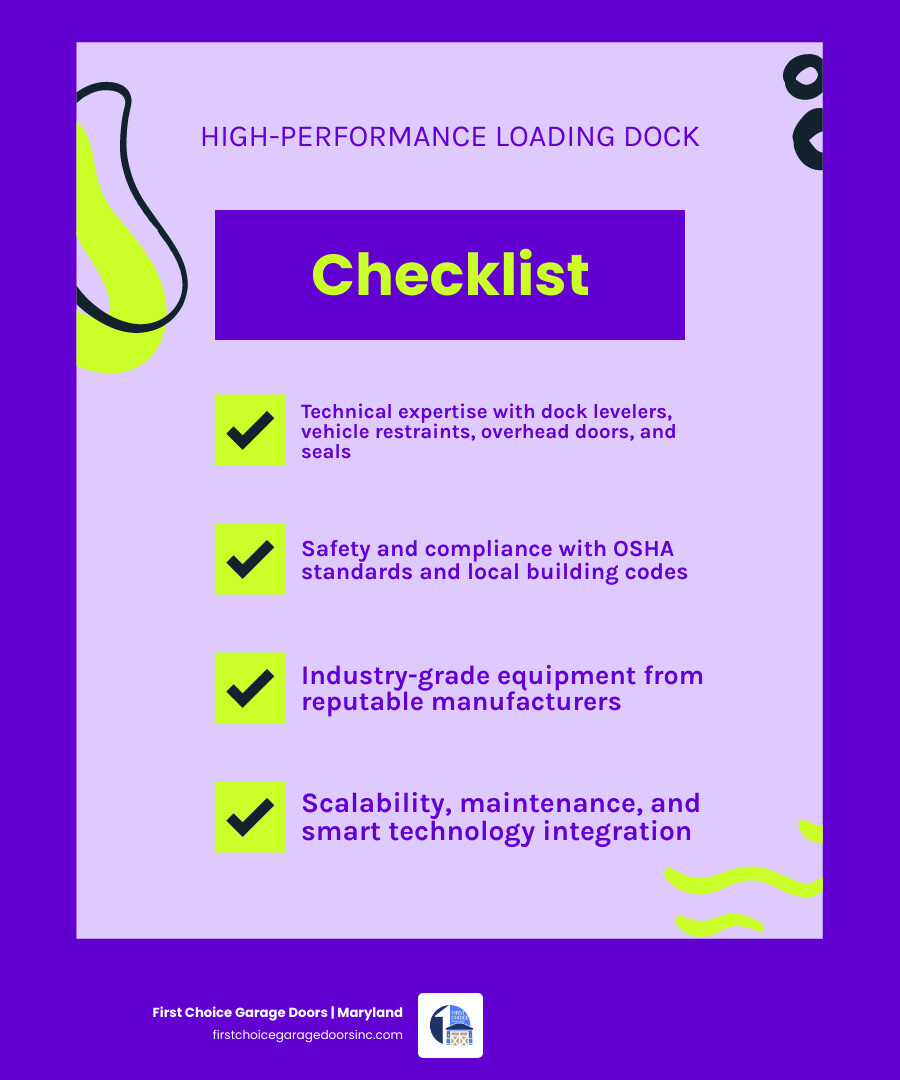
Here’s what to look for when evaluating a commercial loading dock provider:
- Technical expertise – Experience with dock levelers, vehicle restraints, overhead doors, and seals
- Safety and compliance – Alignment with OSHA standards and current local building codes
- Equipment quality – Use of industry-grade products from reputable manufacturers
- Scalability – Ability to support your operation as volume grows
- Maintenance and support – Preventative care, emergency response, and clear communication
- Technology integration – Smart features, automation, and real-time tracking capabilities
- Local expertise – Knowledge of Maryland-specific requirements and fast response times
There are over 10 million loading docks across the U.S., and they handle the movement of virtually every product that reaches a consumer. Yet loading docks are also high-traffic zones — in 2019, transportation and warehousing workers experienced injuries at a rate of 4.4 per 100 full-time employees. A poorly equipped or poorly maintained dock doesn’t just slow your business down. It puts your people at risk.
With the global logistics market projected to reach $14.37 trillion by 2028, and 62% of shoppers now expecting free delivery in under three business days, the pressure on commercial facilities to perform faster and safer has never been higher. Your loading dock is the gateway to your entire operation — and the provider you choose to equip, install, and maintain it will shape how well you meet those demands.
Essential Criteria for Choosing a Provider with Loading Dock and Commercial Capabilities
When we talk about a loading dock, we aren’t just talking about a hole in the wall. It’s a complex ecosystem of loading dock equipment and accessories that must work in perfect harmony. If one part fails—whether it’s a leveler that won’t rise or a door that won’t open—your entire supply chain feels the “traffic jam.”

A high-quality provider doesn’t just sell you parts; they look at your facility’s workflow. Are you handling heavy industrial equipment in Frederick or high-volume retail fulfillment in Columbia? The design of your dock should reflect your specific logistics management needs. We believe that the top loading dock equipment companies serving Northern Virginia and Maryland are those that prioritize custom design over a one-size-fits-all approach.
Assessing Technical Expertise when Choosing a Provider with Loading Dock and Commercial Capabilities
Technical expertise is the backbone of a reliable dock. You need a team that understands the nuances of different systems. For instance, various kinds of commercial garage doors require different spring configurations and motor ratings depending on how many times they open per hour.
Furthermore, your provider should be well-versed in pit levelers. While mechanical levelers are common, many modern Maryland facilities are moving toward hydraulic or air-powered systems. Hydraulic levelers, while often requiring a higher initial investment, tend to save significantly on long-term repair costs because they have fewer moving parts to wear out. When browsing commercial garage doors, ensure your provider can also speak to the integration of these doors with your leveler systems.
Evaluating Reputation and Industry Experience
In commercial logistics, a provider’s history tells a story. You want a partner with a deep service history in the local area. Whether you are looking at a commercial garage door repair Columbia guide or seeking installation in Easton, local expertise matters.
Maryland-specific knowledge is vital because our weather can be unpredictable. From the humid summers on the Eastern Shore to the freezing winters in Frederick, your equipment needs to withstand the elements. Look for client testimonials that highlight reliability and promptness—two things we pride ourselves on at First Choice Garage Doors.
Prioritizing Safety and Regulatory Compliance
Safety is non-negotiable. The loading dock is statistically one of the most dangerous areas in any facility. Between heavy forklifts, massive trailers, and the potential for “trailer creep” (where a truck slowly moves away from the dock during loading), the risks are high.
A reliable provider will ensure your setup meets all OSHA standards. We often point clients toward our Northern Virginia guide to loading dock safety and protection to help them understand the layers of protection needed to prevent workplace injuries.
Implementing Advanced Protection Features
To truly protect your team, you need more than just the basics. Consider these advanced features:
- Vehicle Restraints: These lock the trailer’s rear impact guard (ICC bar) to the building, preventing the truck from pulling away prematurely.
- Dock Bumpers: Heavy-duty rubber bumpers absorb the impact of a backing trailer, protecting your building’s foundation.
- LED Signal Lighting: Clear “Red/Green” light systems communicate safety status to both the truck driver and the forklift operator.
- Preventative Maintenance: Regular commercial garage door maintenance ensures that safety sensors and auto-reverse features are always functioning.
Maintaining Compliance in 2026
As we move through 2026, regulatory alignment is becoming stricter. Safety audits are no longer just a suggestion; they are a necessity for staying operational. Your provider should help you choose from different kinds of commercial garage doors that include built-in safety features, such as vision panels (to see if someone is on the other side) and high-speed operation (to minimize the time a door stays open).
Evaluating Technical Features and Smart Integration
The “Smart Warehouse” is no longer a futuristic concept—it’s the standard for 2026. Choosing a provider with loading dock and commercial capabilities now involves looking at how equipment integrates with your Warehouse Management System (WMS).
Automation can significantly reduce loading and unloading times. For example, automated dock levelers can be programmed to deploy with a single button press, reducing manual labor and the risk of operator error.
Future-Proofing Operations by Choosing a Provider with Loading Dock and Commercial Capabilities
Scalability is a major factor in long-term success. If your business in Frederick is planning to add three more bays next year, your current provider should be able to design a system that grows with you. This includes:
- Smart Sensors: Detecting when a trailer is present and automatically triggering lights or climate control.
- Data Analytics: Tracking how long doors stay open and how many cycles each leveler performs to predict maintenance needs.
- 3PL Integration: Ensuring your dock software can “talk” to third-party logistics providers for real-time tracking of goods.
Enhancing Efficiency with Modern Equipment
Efficiency often comes down to climate control and speed. High-speed doors are a fantastic investment for facilities that need to maintain strict temperature zones, such as cold storage. By browsing the various kinds of commercial garage doors, you can find insulated options that provide superior thermal protection, keeping your energy bills low and your cargo safe.
Building a Long-Term Maintenance Partnership
The relationship with your provider shouldn’t end when the last bolt is tightened. In fact, that’s just the beginning. Loading docks are mechanical systems that take a beating every single day. Without a solid preventative maintenance plan, even the best equipment will eventually fail.
We emphasize commercial garage door maintenance tips because we know that a small adjustment today can prevent a catastrophic failure tomorrow. When a door goes down in a high-volume facility, it doesn’t just stop one truck; it creates a backlog that can take days to clear.
Ensuring Seamless Warehouse Integration
Operational continuity is the goal. Your provider should understand your facility layout so well that they can perform repairs without shutting down your entire operation. Whether you need a commercial garage door repair in Columbia or a retrofit in Frederick, the focus should always be on equipment longevity and minimizing downtime.
Strategic Communication and Feedback
A true partnership is built on clear communication. This often takes the form of Service Level Agreements (SLAs) that define response times for emergency repairs. If a spring breaks at 3:00 AM, do you have a partner who will answer the phone?
By choosing a provider that offers a wide range of different kinds of commercial garage doors, you ensure that you always have access to the right parts and expertise as your facility evolves. Continuous improvement is the name of the game in 2026.
Frequently Asked Questions about Commercial Loading Docks
What are the most common types of dock levelers?
There are four primary types of levelers used in Maryland warehouses:
- Mechanical Levelers: Use a pull-chain and spring system. They are cost-effective but require more manual effort and frequent maintenance.
- Hydraulic Levelers: Operated by a push-button, these are the most reliable and require the least maintenance over time.
- Air-Powered Levelers: Use a high-volume, low-pressure air bag to raise the platform. They are a great middle-ground between mechanical and hydraulic.
- Edge-of-Dock Levelers: Mounted to the face of the dock rather than in a pit. These are ideal for facilities with limited space or where trailers are always a consistent height.
Why are dock seals and shelters necessary for climate control?
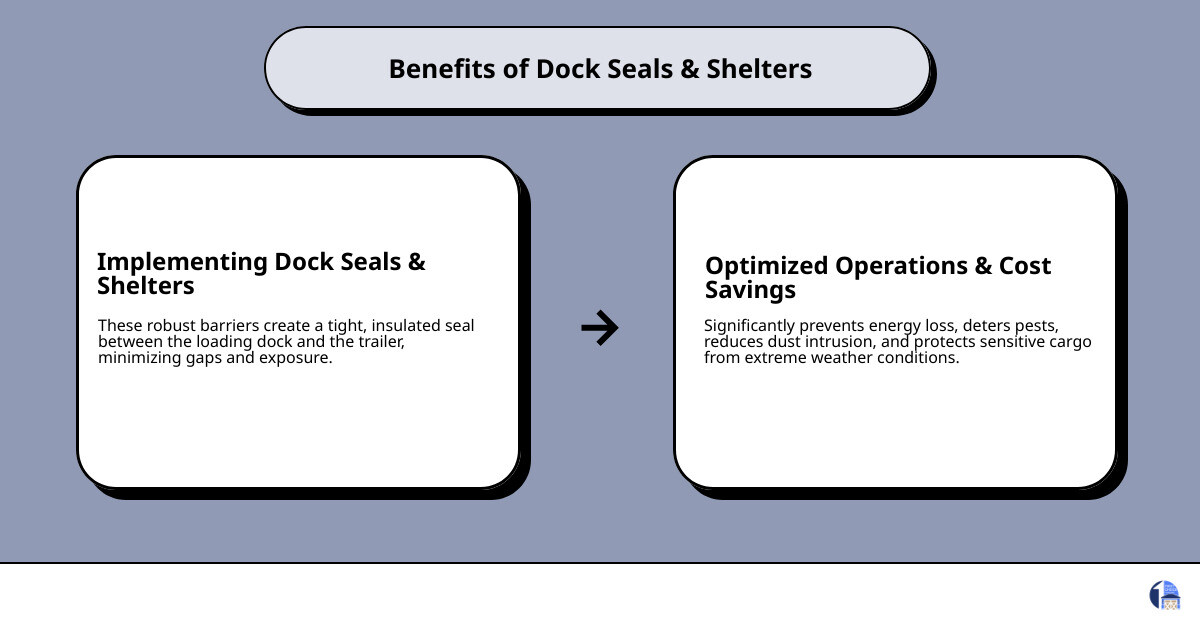
Dock seals and shelters create an airtight seal between the back of the trailer and the building. This is essential for:
- Energy Savings: Preventing expensive heated or cooled air from escaping.
- Pest Prevention: Keeping bugs, birds, and rodents out of your clean warehouse environment.
- Cargo Protection: Ensuring rain, snow, and wind don’t damage your products during the loading process.
How does an interlocking system improve warehouse safety?
An interlocking system is a “smart” safety feature that sequences dock operations. For example, the system can be set so that the overhead door cannot be opened unless the vehicle restraint is securely locked onto the trailer. This prevents “forklift fallout,” where a driver accidentally drives a forklift off an open dock when no trailer is present.
Conclusion
Choosing a provider with loading dock and commercial capabilities is about more than just buying equipment—it’s about investing in the safety, efficiency, and future of your business. At First Choice Garage Doors, we bring unmatched Maryland commercial expertise to every project. From Easton to Frederick, our commitment to quality assurance and safety ensures your gateway stays open and your operations keep moving.
Ready to optimize your facility? Explore our professional commercial services and see how we can help you build a safer, faster loading dock today.